Plant Trivia
True / False
True / False
True / False
True / False
Plant-Part Vocabulary Traps: Roots, Tubers, Bulbs, and Rhizomes
Mistaking “Abeka” for a plant structure
Prompts like “the part of the plant that grows below the ground is called…” can be misread as asking for “Abeka.” Abeka is the curriculum name. The expected plant part is usually root unless the question shows a modified stem (bulb, tuber, rhizome).
Using location only, instead of structure and function
“It is underground, so it is a root” fails on many items. A true root typically anchors the plant and absorbs water and minerals. Many underground stems are mainly for storage or regrowth.
Calling familiar foods “roots” by default
- Potato: a tuber (underground stem) with buds called “eyes.”
- Onion: a bulb (short stem) with thick, layered storage leaves.
- Ginger: a rhizome (horizontal underground stem) with nodes.
Ignoring stem clues that appear underground
Stem modifications often show nodes, joints, rings, scales, or buds. If you can point to “places where a shoot could start,” that feature pushes the answer toward stem, not root.
Over-specific answers when the prompt is broad
If the wording only asks for the part that grows below the ground, answer root. Save taproot versus fibrous roots for prompts that describe one main root or a spreading root mass.
Printable Abeka Plant Parts Cheat Sheet: Roots vs Underground Stem Types
Print or save as PDF: Use your browser’s Print option, then choose “Save as PDF” for a one-page study sheet.
Core plant-part definitions (Abeka-style)
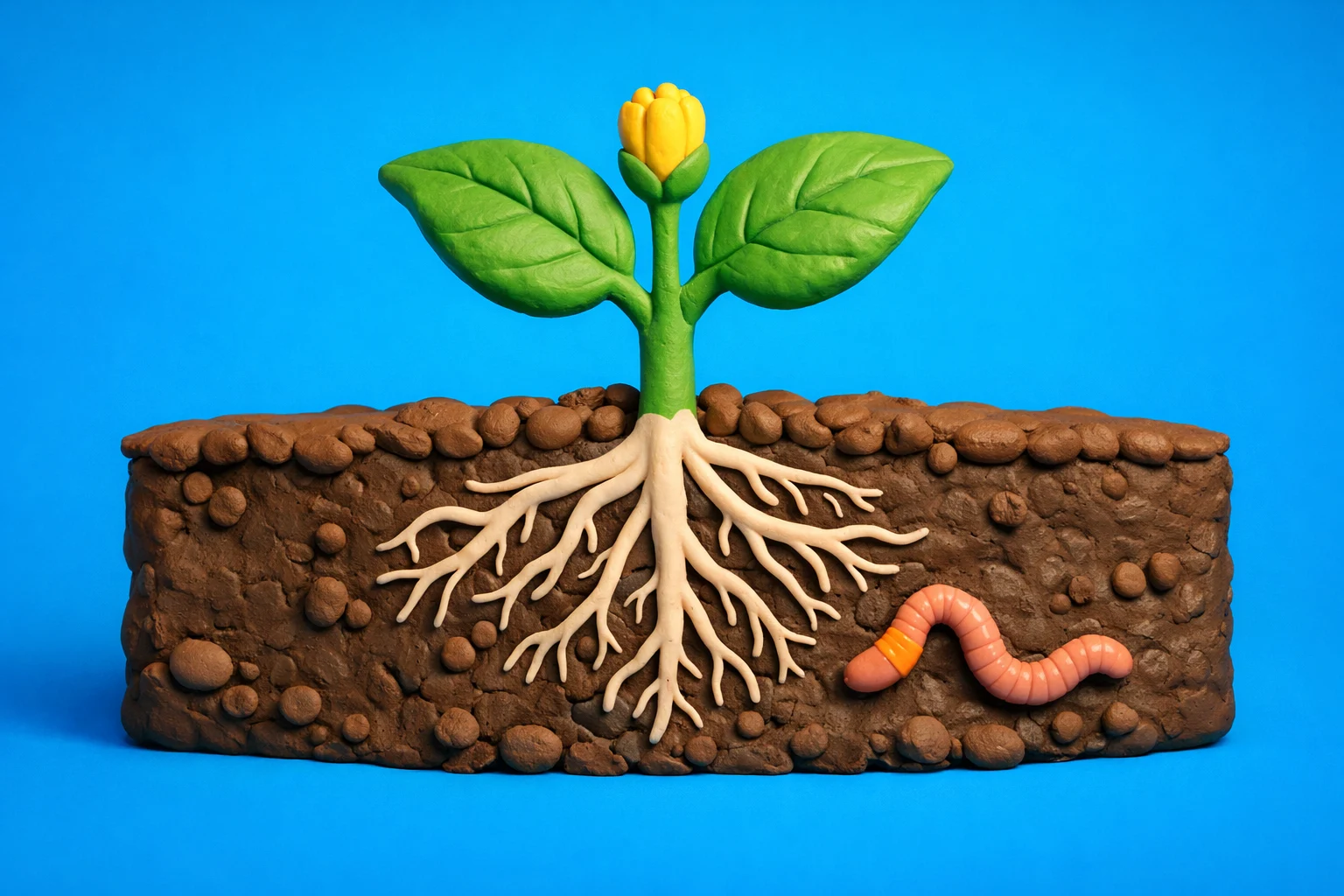
- Root: grows below the ground, anchors the plant, and absorbs water and minerals.
- Stem: supports leaves and flowers, and moves water, minerals, and food between roots and the rest of the plant.
- Leaf: makes food by photosynthesis.
- Flower: reproductive structure that can form seeds and fruit.
- Fruit: mature ovary that contains seeds.
Below-ground parts that trigger wrong answers
- Taproot: one main root with smaller side roots. Quick clue: one thick “carrot-like” root.
- Fibrous roots: many thin roots spreading from the base. Quick clue: grass-like root mass.
- Bulb (onion): short stem with thick, layered storage. Quick clue: layers or “scales.”
- Tuber (potato): swollen storage stem. Quick clue: buds or “eyes.”
- Rhizome (ginger): horizontal underground stem that can make new shoots. Quick clue: nodes, segments, or joint-like sections.
Fast decision checklist (use on any question)
- What job is emphasized? Absorb and anchor points to root. Storage and regrowth points to a modified stem.
- What features are visible? Buds, nodes, rings, layers, or “eyes” point to stem modifications.
- How would a new shoot start? If the structure has obvious “starting points,” it is usually stem tissue (tuber or rhizome).
- Is the prompt broad? If it only says “part below the ground,” pick root unless clear stem clues are provided.
Common examples to memorize
- Carrot: taproot
- Grass: fibrous roots
- Onion: bulb
- Potato: tuber
- Ginger: rhizome
Worked Plant Trivia Examples: Choosing Root vs Tuber vs Bulb vs Rhizome
Example 1: “The part of the plant that grows below the ground and absorbs water and minerals”
- Identify the function words. “Absorbs water and minerals” is the key phrase.
- Match function to plant part. Absorption and anchoring are root functions in Abeka vocabulary.
- Check for any stem-modification clues. The prompt does not mention layers, joints, or buds.
- Answer. Root.
Example 2: “This underground plant part stores food and has ‘eyes’ that can sprout”
- Spot the structure clue. “Eyes” are buds.
- Interpret buds underground. Buds indicate stem tissue because stems have nodes and can form shoots.
- Pick the correct modified stem. A swollen underground storage stem with buds is a tuber.
- Answer. Tuber (classic example: potato).
Example 3: “An underground part with thick layers like scales, often used in cooking”
- Spot the layer clue. “Thick layers” and “scales” point to a bulb structure.
- Separate from roots. Roots do not form concentric storage layers like an onion.
- Answer. Bulb.
Example 4: “A horizontal underground structure with segments that can send up shoots at nodes”
- Spot the growth pattern. “Horizontal” plus “nodes” signals a stem running underground.
- Choose the term. That is a rhizome.
- Answer. Rhizome.
Plant Trivia FAQ: Interpreting “Below Ground” Wording in Abeka-Style Questions
Why do some prompts mention “Abeka” next to plant parts?
Abeka is a curriculum and textbook series. If a question stem includes “Abeka-style” wording, it is describing the vocabulary set, not naming a plant structure. For the classic prompt about the part that grows below the ground and absorbs water and minerals, the expected answer is root.
How can I tell a true root from an underground stem in one step?
Look for buds, nodes, rings, or layered scales. Those features point to stem tissue (tuber, rhizome, bulb). If the prompt emphasizes anchoring and absorbing water and minerals with no stem clues, choose root.
Why is a potato a tuber instead of a root?
Potatoes have “eyes,” which are buds that can sprout into new shoots. Buds are a stem feature. In Abeka-style classification, that makes a potato a tuber, which is a swollen underground stem used for storage.
Why is an onion a bulb instead of a root?
An onion has thick, layered storage tissues often described as scales. A bulb is a short stem with fleshy storage layers. Roots do not form those concentric layers, and they do not have the same shoot-forming structure at the center.
What wording should push me toward “root” as the answer?
Choose root when the prompt centers on “grows below the ground” plus absorbs water and minerals, or mentions anchoring the plant. Use taproot or fibrous roots only if the question describes one main root versus many thin roots.
Where can I get more practice on plant parts beyond this page?
For broader plant questions that go past roots and underground stems, use Practice Plant Trivia Questions With Answers. If you want science vocabulary practice that overlaps with plant structure and function, try Environmental Science Knowledge Check With Answers.
Looking for more? Browse more Education & Academics quizzes on QuizWiz or explore the full QuizWiz workplace quiz library.