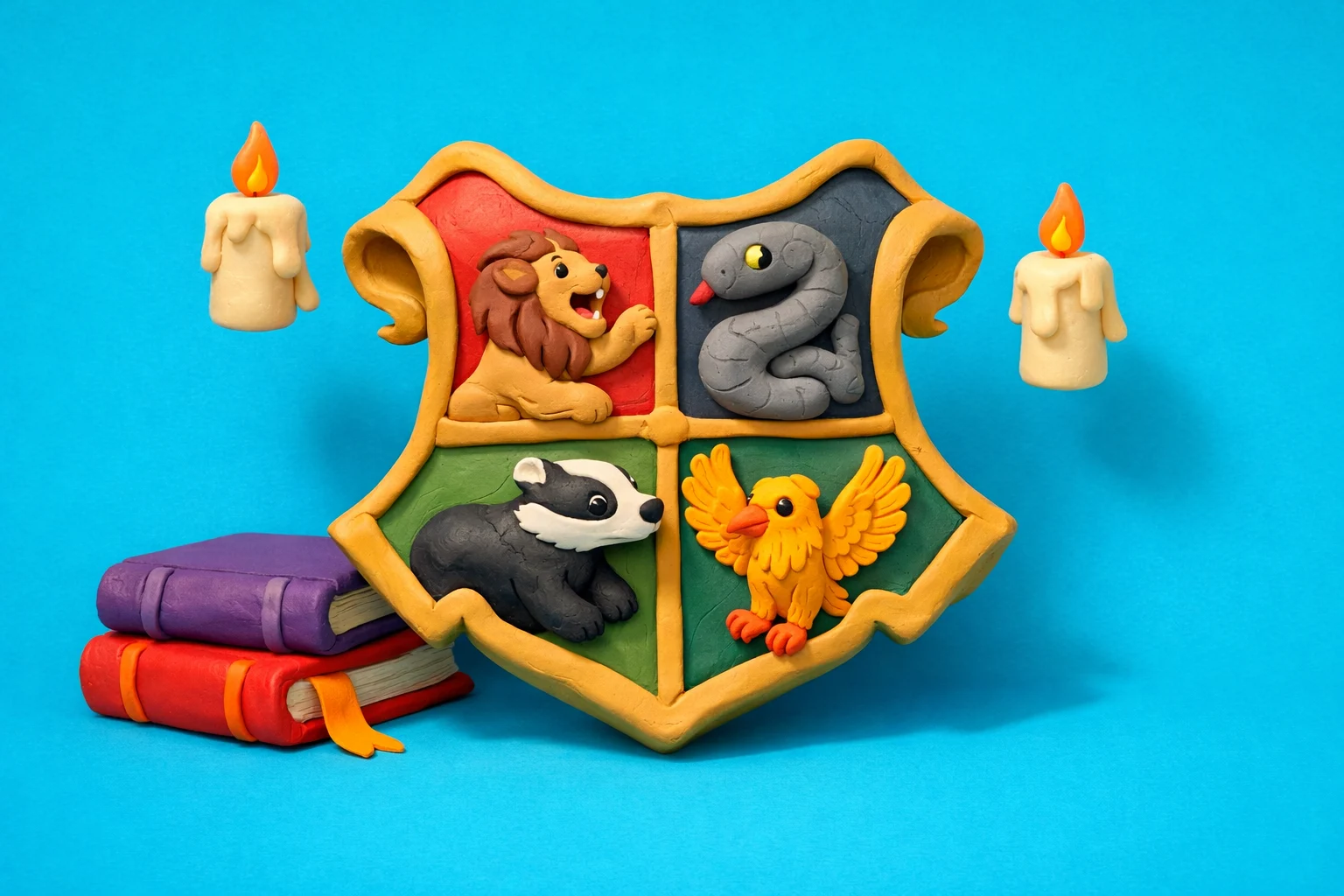
Hogwarts Sorting Hat - claymation artwork

Hogwarts Sorting Hat Quiz

8 – 12 Questions 4 min
This Hogwarts Sorting Hat quiz tracks what actually tips the Hat, your instincts, your values under pressure, and the kind of power you reach for when nobody is watching. Answer like you are already in the castle, mid-drama, mid-decision. Then share your house and compare the tiny tells that split brave, clever, loyal, and ambitious.
1The Sorting Hat drops onto your head and goes quiet for a beat. What are you silently thinking?
2You spot a hidden door behind a tapestry. It is slightly ajar. What do you do?
3Dueling Club is packed. Someone calls you out in front of everyone. Your move?
4Professor Flitwick assigns a group Charm project. Your role shows up fast. Which one?
5In the corridor, an older student is mocking a first year. What do you do?
6A mysterious owl brings you a “shortcut” to popularity. It costs a favor later. Your reaction?
7Pick a Hogwarts companion animal. Which one fits you best?
8You can only take one elective. Which class do you grab?
9Your wand misfires in class. Sparks everywhere. People stare. What do you do first?
10You are offered a shortcut through the Forbidden Forest. It saves time, but it feels wrong. What is your call?
11Which common room feels like home after a rough day?
12A boggart appears in Defense Against the Dark Arts. Your fear twists into something. What hits hardest?

Four Houses, Four Answer Signatures

Gryffindor

You land here when your answers keep choosing moral courage over comfort. You tend to act first, even if it is messy, and you will take heat to protect someone. Patterns that point Gryffindor include volunteering, confronting unfairness, and picking the risky option because it feels right.

Slytherin

This result shows up when you value agency, strategy, and self-preservation without apologizing for it. Your answers often favor long-term positioning, keeping leverage, and reading people fast. Slytherin patterns include choosing influence, optimizing resources, and refusing to be naive about stakes.

Ravenclaw

Ravenclaw wins when your decisions orbit curiosity and independent thinking. You pick the option that teaches you something, even if it is not the quickest. Ravenclaw patterns include asking follow-up questions, enjoying complexity, and preferring elegant solutions over dramatic wins.

Hufflepuff

You get Hufflepuff when your answers consistently protect people and process. You value fairness, reliability, and showing up again tomorrow. Hufflepuff patterns include mediating conflict, doing unglamorous work, and choosing community trust over personal spotlight.

How close matches work

If two houses feel neck-and-neck, look at which motive repeats under stress. Gryffindor is about courage, Slytherin is about control, Ravenclaw is about understanding, and Hufflepuff is about commitment.

Sorting Hat Quiz FAQ: Accuracy, Ties, and Retakes

How accurate is this, compared to the Sorting Hat in the books?

It is as accurate as your self-reporting. The Hat reacts to patterns of motive, not single flashy moments. Answer from your default behavior in conflict, friendship, and temptation. If you role-play a cooler version of yourself, you will get a cooler, less true house.

What if I feel like I am two houses at once?

That is normal. Many people sit on a Gryffindor, Slytherin edge (brave ambition), Ravenclaw, Hufflepuff edge (curious kindness), or Gryffindor, Hufflepuff edge (protective loyalty). Use your top two as a “primary house plus a secondary vibe,” especially for character building.

How do ties or super close matches get decided?

Close scores usually break on a few high-signal choices: risk tolerance (Gryffindor), influence seeking (Slytherin), curiosity for its own sake (Ravenclaw), and consistency in support roles (Hufflepuff). If you keep getting ties, re-read your answers and mark the ones you picked “because it sounded right.”

Can I retake it without breaking the spell?

Yes. Retake with a different lens: answer as you are during exams, during friend drama, or during a rules-versus-people moment. If your house changes each time, you are probably answering for the situation, not your core motive.

I got a house I did not want. Is that a bad sign?

No house is a punishment. If the result stings, that is useful information. Ask what value you are judging, ambition, attention-seeking bravery, aloof cleverness, or people-pleasing loyalty. Then decide what kind of witch or wizard you want to practice being.

How should I use this for Hogwarts Legacy role-play?

Use your result to pick dialogue tone and problem-solving style. Gryffindor pushes direct action, Slytherin plans and negotiates, Ravenclaw investigates and experiments, and Hufflepuff protects classmates and finishes the unglamorous quests.

Sorting Hat Lore Nuggets Fans Love to Quote

The Hat cares about values, not aesthetics

House colors and vibes are fun, but the Sorting Hat keeps circling back to what you admire and what you will do when you are scared.

Choice matters, and the series says it out loud

  • Hatstall energy: Long deliberations happen in canon. If your result feels close, you are in good company.
  • Gryffindor is not just loud bravery: Quiet defiance, apologizing first, and taking consequences for a friend are peak lion behavior.
  • Slytherin is not “evil mode”: Resourcefulness and ambition read differently depending on how you treat people while you climb.
  • Ravenclaw is not “straight-A student”: Curiosity can look like daydreaming, tinkering, or arguing about one weird detail for an hour.
  • Hufflepuff is not background noise: Loyalty shows up as consistency. It is the friend who stays after the scene ends.

Hogwarts Legacy wink

The game quietly reinforces house stereotypes through companion vibes. Sebastian reads as bold and calculating, Poppy has fierce loyalty, Natty runs toward danger for the right reasons, and Amit keeps chasing the interesting answer.

Shareable argument starter

Ask friends one question after they get their house: “What did you protect in your answers, your pride, your people, your plans, or your curiosity?”